Biohazard Cleaning Products
Biohazard Cleaning Products
When blood, vomit, or other infectious materials show up unexpectedly in your workplace, standard household cleaners simply won’t cut it. Biohazard cleaning products are specialised formulations designed to safely clean, disinfect, and contain potentially hazardous biological materials—protecting everyone from further contamination and keeping your facility compliant with health and safety regulations.
In this guide, you’ll learn exactly what biohazard cleaning supplies you need, how to use them effectively, and why choosing the right products matters for your specific environment.
Biohazard Cleaning Products: Quick Overview
Biohazard cleaning products are specialised chemicals, tools, and protective equipment used to safely handle blood, body fluids, sharps, and other infectious materials in both professional and everyday settings. Unlike regular cleaning supplies, these products meet strict regulatory standards for pathogen elimination and are essential for OSHA compliance.
These products serve a critical function: they break down organic matter, kill dangerous pathogens (including bloodborne viruses), and enable safe disposal of contaminated materials. Using household cleaners alone—even bleach from the supermarket—doesn’t meet the requirements set out in the OSHA Bloodborne Pathogens Standard or equivalent regulations in the UK and EU.
Typical users of biohazard cleaning products include:
Hospitals, clinics, and dental practices
Schools, universities, and nurseries
Care homes and assisted living facilities
Crime scene and trauma cleaning professionals
Facilities managers in offices, hotels, and public buildings
Small business owners who need to prepare for workplace accidents
From 2024 onwards, regulatory scrutiny has increased, and more organisations are being asked to demonstrate documented access to appropriate biohazard cleaning supplies during health and safety audits.
Stay Safe with Hazmat & Biohazard Cleaning Supplies
Any contact with blood, vomit, urine, faeces, or other bodily fluids carries genuine infection risk. Pathogens like Hepatitis B, Hepatitis C, and HIV can survive on surfaces for days, and even a small exposure through broken skin or mucous membranes can lead to serious illness. This is why proper hazmat and biohazard supplies are non-negotiable for any workplace.
Key Hazard Categories
Biohazard cleaning products are designed to address three main hazard types:
Hazard Type | Examples | Risk Level |
|---|---|---|
Bloodborne pathogens | HIV, Hepatitis B, Hepatitis C | High |
Chemical residues | Contaminated liquids, drug residue | Medium to High |
Contaminated sharps | Used needles, broken glass with blood | High |
Core Product Groups
To deal with these hazards safely, you’ll need supplies from several categories:
Absorbent granules: Products like 1 lb shaker bottles of cellulose-based powder that solidify liquid spills for easier collection
Disinfectant sprays and wipes: EPA-registered, hospital-grade formulations in formats like 32 oz ready-to-use sprays or 100-wipe canisters
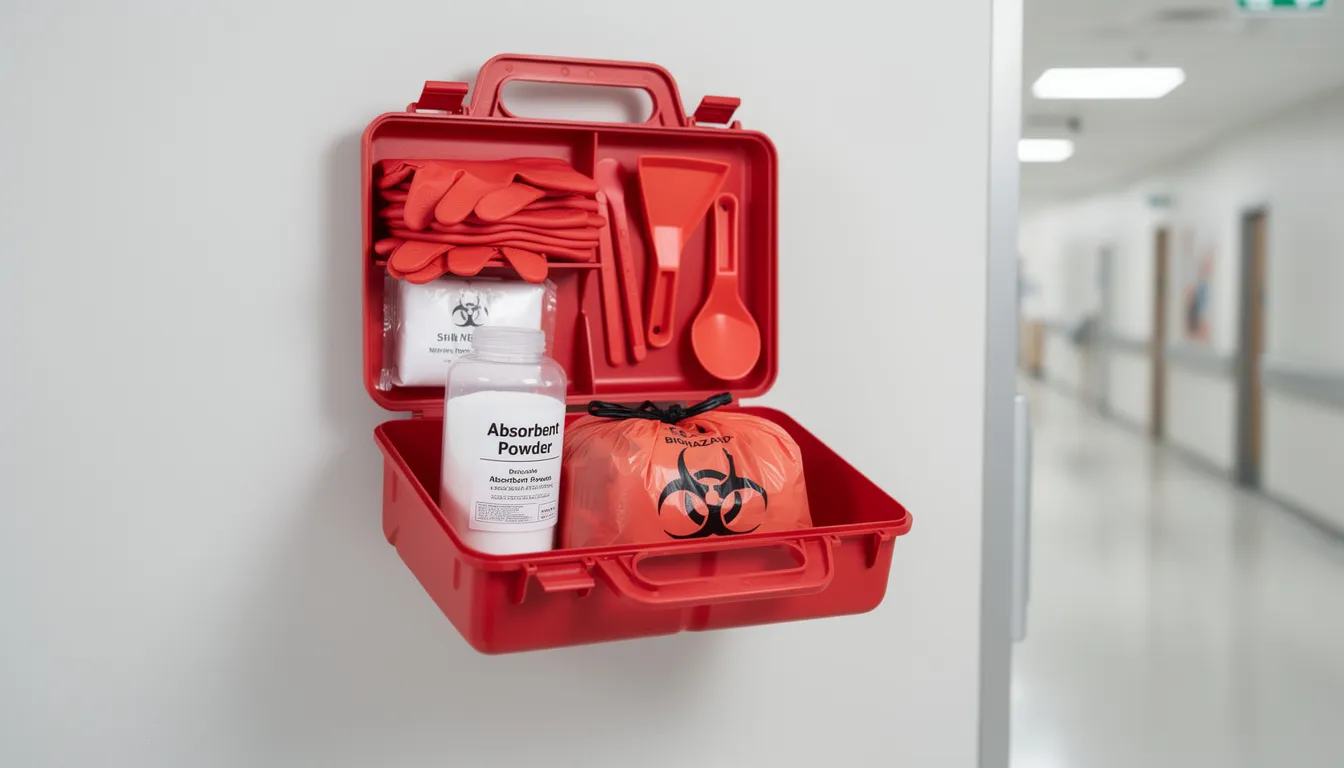
Spill kits: Pre-assembled kits containing everything needed for immediate response
Sharps containers: Puncture-resistant, leak-proof containers for needles, lancets, and contaminated glass
Personal protective equipment: Disposable gloves, gowns, face shields, and respirators
These hazmat supplies protect both professional cleaners who deal with biohazard incidents daily and untrained staff who may be first on the scene of an accident at work or school. Having the right equipment readily available can mean the difference between a contained incident and widespread contamination.
Why Proper Hazardous Material Removal Matters
Improper cleanup of hazardous materials doesn’t just look bad—it can leave infectious residue on floors, desks, door handles, and vehicle interiors for days or even weeks. Pathogens like Hepatitis B can remain viable on dry surfaces for up to seven days, creating ongoing exposure risk for anyone who comes into contact with the contaminated area.
Legal and Regulatory Context
In the United States, the OSHA Bloodborne Pathogens Standard (29 CFR 1910.1030) requires employers to provide appropriate engineering controls, personal protective equipment, and work practice controls whenever employees might be exposed to blood or other potentially infectious materials. Similar regulations exist across the UK and EU, with specific requirements for medical waste handling and disposal.
Why Correct Removal Matters
Proper hazardous material removal delivers several critical benefits:
Reduced long-term contamination: Correct cleaning and disinfection eliminates pathogens rather than spreading them
Protection for cleaning teams: Proper PPE and products prevent secondary infections among cleanup staff
Business continuity: Avoiding costly closures, fines, or legal action after incidents
Audit compliance: Documented use of approved products supports insurance claims and regulatory inspections
Real-World Environments
Consider these scenarios where proper biohazard cleaning is essential:
Emergency rooms: Blood spills during trauma care require immediate, thorough decontamination between patients
Dental practices: Blood and saliva contamination is routine; surfaces must be disinfected between every patient
School nurse offices: Children with nosebleeds, vomiting, or accidents need quick cleanup to get spaces back in use
Public transport vehicles: A bus or taxi with a passenger who vomits needs proper cleaning before returning to service
In each case, documented use of approved biohazard cleaning products and correct disposal into red biohazard bags or sharps containers supports your organisation’s incident reporting and demonstrates compliance during audits.
Who Needs Biohazard Spill Response Supplies?
Biohazard incidents aren’t limited to hospitals and crime scenes. A retail worker with a severe nosebleed, a restaurant customer who vomits, or an office employee who cuts themselves on broken glass—these are everyday scenarios that require proper spill response supplies.
Settings That Need Biohazard Supplies
Healthcare facilities
Clinics, GP surgeries, and care homes deal with bodily fluids daily
Example: A diabetic patient’s lancet-stick blood test leaves droplets on the examination table
Education settings
Nurseries, schools, and universities see frequent minor injuries and illness
Example: A nosebleed on classroom carpet in a primary school requires absorbent granules and disinfection
Hospitality venues
Restaurants, hotels, and pubs handle food poisoning incidents and intoxicated guests
Example: Vomit in a hotel corridor on a Saturday night needs immediate containment
Transport services
Taxis, buses, trains, and aircraft carry passengers who may become ill or injured
Example: A passenger bleeding from a minor accident in a rideshare vehicle
Facility management companies
Office buildings, shopping centres, and public venues require emergency response capability
Example: Blood on a bathroom floor in a busy office building
Having ready-to-use spill response kits with absorbent powder, scoop, scraper, disinfectant, and red biohazard bags dramatically shortens response time. Even low-risk offices benefit from at least one compact blood and body fluid spill kit stored near first aid supplies—the cost is minimal compared to the risk of improper handling.
Types of Biohazard Cleaning Products
Biohazard cleaning products fall into six main categories, each serving a different step in the cleanup process. Understanding what each product type does—and when to use it—helps you build a complete kit that covers every stage from initial response to final disposal.
Products are typically grouped into PPE, absorbents, disinfectants, spill kits, sharps management, and odour control. Let’s look at each category in practical terms.
Personal Protective Equipment (PPE)
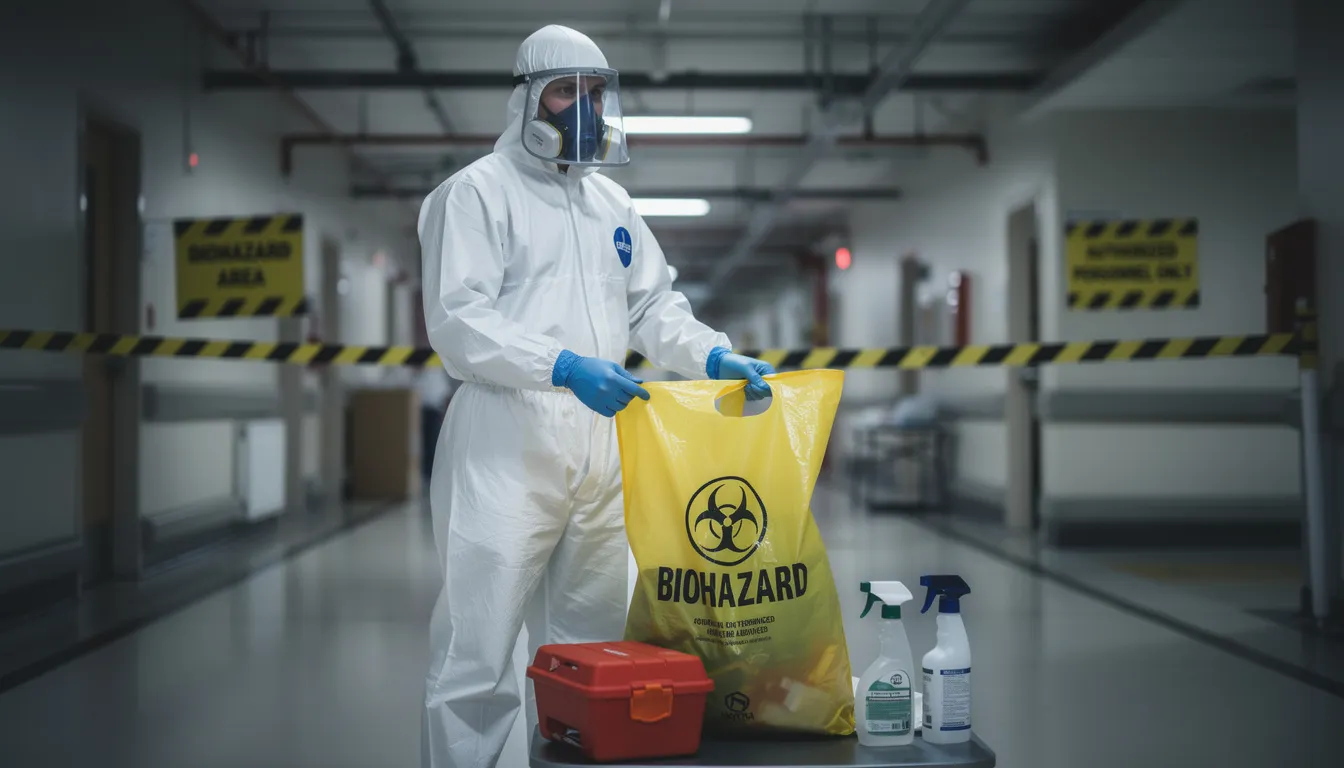
Personal protective equipment forms the first barrier between the worker and infectious material. All PPE used during biohazard cleanup should be disposable—never reused—to prevent cross contamination.
Core PPE items include:
Item | Purpose | Standards to Look For |
|---|---|---|
Nitrile gloves (powder-free) | Hand protection from fluids | EN 374 for chemical resistance |
Fluid-resistant coveralls | Full body protection | Type 5/6, EN 14126 for infectious agents |
Eye protection or face shields | Splash protection for eyes | EN 166 |
Fluid-resistant gowns | Upper body protection | EN 13795 |
Shoe covers | Prevent tracking contamination | Fluid-resistant material |
FFP2/N95 respirators | Protection from airborne pathogens | EN 149 or NIOSH-approved |
Donning and doffing sequence matters. Put on PPE in this order: gown, mask, eye protection, gloves. Remove in reverse, taking care not to touch outer surfaces. Always perform hand hygiene immediately after removing gloves—this single step prevents many secondary exposures.
Absorbent Powders and Granules
Absorbent products turn liquid spills—blood, vomit, urine—into semi-solid material that’s far easier and safer to collect. Rather than spreading contaminated liquids around with mops, absorbent granules encapsulate the fluid in place.
Typical formats include:
Granular absorbent in 1 lb or 500 g shaker bottles
Bulk bags for high-volume environments
Some products include light fragrance for initial odour control
Most absorbent granules are either cellulose-based or mineral-based, capable of absorbing many times their own weight in liquid. Cellulose-based products are particularly effective on blood due to their high absorption capacity.
Simple usage steps:
Sprinkle granules liberally over the entire spill
Allow 2-5 minutes dwell time (check product instructions)
Collect solidified material with disposable scoop and scraper
Transfer directly into red biohazard bags
Proceed to disinfection of the affected surface
Disinfectants and Surface Cleaners
There’s an important distinction between cleaning and disinfection. Cleaning removes visible soil and organic matter; disinfection kills pathogens. Both steps are required for proper biohazard remediation—disinfectant alone won’t penetrate through blood or tissue.
Common active ingredients in biohazard disinfectants:
Active Ingredient | Strengths | Limitations |
|---|---|---|
Sodium hypochlorite (bleach) | Broad spectrum, sporicidal, low cost | Corrosive, strong odour, degrades over time |
Hydrogen peroxide | Good material compatibility, breaks down to water | Less stable, can be inactivated by organic matter |
Quaternary ammonium compounds | Low odour, surface-friendly | Limited sporicidal activity |
Peracetic acid | High-level disinfection, sporicidal | Requires careful handling |
Product formats you’ll encounter:
Ready-to-use sprays in 750 ml bottles for immediate response
Pre-saturated disinfectant wipes in 100-wipe canisters for surfaces and equipment
5 L concentrate jerrycans for large facilities requiring dilution
Contact time is critical. Most products require the surface to remain visibly wet for 1-10 minutes to achieve full bactericidal and virucidal activity. Always check the product label—cutting contact time short means pathogens may survive.
Complete Biohazard Spill Kits
Spill kits bundle PPE, absorbent, disinfectant, and disposal bags in one tamper-evident container, ready for emergencies. This eliminates the scramble to find individual components during an incident.
Common kit types:
Small single-use kits: Ideal for schools, dental practices, and small offices. Contains enough supplies for one moderate spill.
Multi-use wall-mounted kits: Suitable for factories, care homes, and larger facilities. Restockable components.
Vehicle spill kits: Compact packs for taxis, ambulances, and fleet vehicles.
Typical kit contents:
Disposable gloves (multiple pairs)
Apron or gown
Face mask and eye protection
Absorbent powder or pads
Scoop and scraper
Disinfectant wipes or sachets
Red biohazard waste bags with ties
Laminated instruction card (updated to 2023-2024 guidelines)
Store kits in clearly marked, accessible locations. Check contents at least annually for expiry dates—disinfectants lose effectiveness over time, and PPE materials can degrade.
Sharps Containers and Disposal Accessories
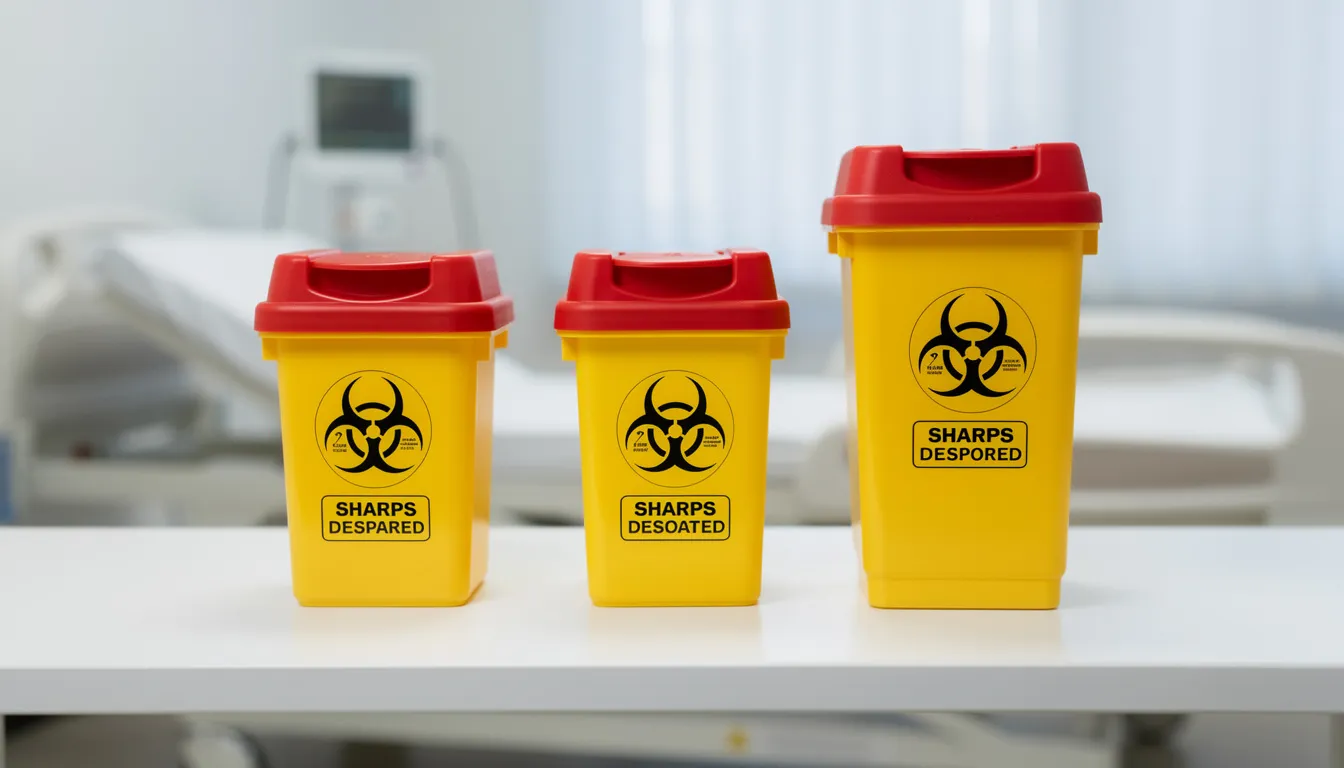
Sharps containers are puncture-resistant, leak-proof, and clearly labelled containers specifically designed for needles, scalpels, lancets, and broken glass contaminated with blood. Never dispose of sharps in regular biohazard bags—needles can easily puncture through, creating serious injury risk.
Available sizes for different settings:
Size | Typical Use |
|---|---|
1 qt (1 L) | Personal use, home healthcare |
5 qt (4-5 L) | Ward containers, dental surgeries |
8 gal (30 L) | Floor-standing units for busy medical areas |
Key features to look for:
One-way openings that prevent removed sharps from falling out
Temporary closure for ongoing use and permanent closure for disposal
Clear fill lines indicating when the container is ¾ full (maximum safe capacity)
UN-approved markings for safe transport to licensed disposal facilities
Additional sharps management tools include forceps or tongs for safe pickup of contaminated sharps without hand contact, and wall brackets for secure mounting of containers in fixed locations.
Odour Control and Deodorisers
Odour control products don’t replace disinfectants, but they’re essential for making environments usable again after severe biohazard incidents. Decomposition, heavy vomit contamination, and sewage exposure can leave persistent odours even after thorough cleaning and disinfection.
Common formats:
Enzyme-based odour neutralisers in trigger sprays: Break down odour-causing organic compounds at the molecular level
Powdered deodorisers for carpets and soft furnishings: Applied, left to work, then vacuumed
Industrial foggers for large rooms: Used by professional trauma cleanup crews after major incidents
Example use case: After cleaning a stairwell where someone was sick, you’ve disinfected all surfaces, but a lingering smell remains. An enzyme-based spray applied to affected areas neutralises the odour rather than masking it.
When using concentrated odour control products, maintain good ventilation and wear appropriate PPE. Some industrial foggers require temporary evacuation of the treated area.
When Is Biohazard Cleaning Equipment Required?
Smart employers plan for biohazard incidents rather than reacting without proper supplies. Having the right equipment on hand before an incident occurs dramatically improves response time and outcomes.
Biohazard cleaning equipment is required whenever you encounter:
Visible blood or body fluids on any surface
Suspected infectious waste (used tissues, soiled clothing)
Used sharps including needles, lancets, or contaminated broken glass
Contamination from deceased persons (unattended deaths, workplace fatalities)
This covers both routine scenarios—minor cuts, nosebleeds, customer sickness in retail environments—and major incidents like serious workplace accidents, crime scenes, or unattended deaths.
Since 2020, many health and safety risk assessments explicitly require documented access to appropriate spill kits and sharps containers. If your facility doesn’t have these supplies, you may be found non-compliant during inspections.
Biohazard Cleaning Products for All Workplaces
Even low-risk environments like offices, retail stores, and community centres should maintain basic biohazard cleaning supplies. Accidents happen everywhere, and having proper equipment ready ensures you can respond correctly.
Essential items for general workplaces:
Compact single-use spill kit
Box of nitrile gloves (multiple sizes)
Disposable aprons
Eye protection
Absorbent granules or pads
Pre-saturated disinfectant wipes
Red biohazard bags with ties
Caution signage or barrier tape
Practical example: A 10-person accounting office keeps one compact blood and body fluid spill kit stored in the cabinet beside their first aid box. When an employee gets a significant paper cut that bleeds onto their desk, a colleague can quickly grab the kit, don gloves and an apron, contain the spill with absorbent material, clean the surface, and dispose of everything properly—all within 15 minutes.
Entry-level kits typically cost less than £30-50, which is trivial compared to potential closure costs, regulatory fines, or legal liability after improper cleanup.
Biohazard Cleaning Products for High-Risk Environments
High-risk environments require significantly more robust biohazard cleaning capabilities. These settings include:
Hospitals and clinics
Laboratories and research facilities
Mortuaries and funeral homes
Veterinary clinics
Industrial sites handling animal by-products
Additional product needs beyond basic kits:
Category | Products Required |
|---|---|
Higher-grade PPE | Full coveralls, powered air-purifying respirators |
Disinfectants | Large-volume containers (5-20 L), concentrate formulations |
Application equipment | Trolleys with colour-coded mops and buckets |
Sharps management | Multiple containers per ward/lab, wall-mounted units |
Verification tools | ATP hygiene monitoring devices, protein residue tests |
Real-world tasks in these environments include terminal cleaning of isolation rooms after infectious patients, operating theatre turnover between surgeries, and mortuary body release cleaning. Each requires written protocols, regular staff training, and products that meet specific healthcare infection-control standards.
Biohazard Cleaning Products for Professional Trauma and Crime Scene Cleaning
Professional trauma cleaning companies handle the most challenging biohazard scenarios: crime scenes, suicides, industrial accidents, and unattended deaths. Their equipment needs go far beyond standard workplace supplies.
Professional-grade equipment includes:
Full-face respirators and powered air-purifying respirators (PAPRs)
Chemical-resistant suits (often Tyvek or similar)
ATP hygiene monitoring devices for verification
High-output fogging machines for large-area disinfection
Industrial enzyme cleaners for heavy organic matter
Multi-stage cleaning process:
Bulk removal: Physical removal of contaminated materials, porous items (carpet, drywall)
Detergent clean: Surfactant cleaning to remove remaining organic soil
Disinfection: EPA-registered hospital-grade disinfectant with full contact time
Odour treatment: Enzyme neutralisers, potentially ozone or hydroxyl generators
Verification: ATP testing or protein residue tests to confirm successful decontamination
Professional crews must comply with local regulations for transport and disposal of category A and B biohazardous waste, including proper documentation, licensed transport vehicles, and disposal at approved facilities.
Choosing the Right Biohazard Cleaning Products
Selecting appropriate biohazard cleaning products means matching products to your specific risks, anticipated incident frequency, and staff training levels. There’s no one-size-fits-all solution—a primary school has very different needs than an ambulance service.
Key Selection Criteria
Type of contaminants: What biological hazards are you most likely to encounter? Blood only? Vomit? Multiple fluid types? Different scenarios require different product specifications.
Volume of potential spills: Small kits work for minor incidents, but larger facilities need bulk supplies and refill capability.
Regulatory requirements: Ensure products meet standards relevant to your region (EPA registration in the US, CE marking in EU, appropriate BSI standards in UK).
Storage and expiry: Consider shelf life, storage temperature requirements, and how often supplies will need replacement.
Reading Product Labels
When evaluating biohazard cleaning products, check labels for:
Spectrum of efficacy: Does it kill bacteria, viruses, fungi, and/or spores?
Contact times: How long must surfaces remain wet for full effectiveness?
Material compatibility: Is it safe on your surfaces (stainless steel, vinyl, upholstery)?
Dilution requirements: Is it ready-to-use or does it require mixing?
Matching Products to Settings
Setting | Typical Needs | Recommended Kit Level |
|---|---|---|
Primary school | Nosebleeds, vomit, minor cuts | Basic single-use spill kit, standard PPE |
Dental surgery | Blood, saliva, sharps | Multi-use kit, sharps containers, hospital-grade disinfectant |
Ambulance service | Heavy blood, trauma situations | Professional-grade kits, high-capacity absorbents, multiple sharps containers |
Care home | Multiple fluid types, frequent incidents | Bulk supplies, restockable kits, comprehensive PPE stocks |
Focus on building a sensible kit list for your environment rather than over-purchasing products you’re unlikely to need.
Why Choose a Specialist Supplier for Biohazard Products?
Purchasing biohazard cleaning products from a specialist supplier rather than generic retail channels offers significant advantages. Specialists understand the compliance landscape and can guide you toward products that actually meet your regulatory obligations.
Benefits of Working with Specialists
Curated product ranges: Every product is selected for biohazard applications, eliminating guesswork about whether something will work for your needs.
Compliance information: Access to Safety Data Sheets, product certifications, and guidance on meeting OSHA, HSE, or other regulatory requirements.
Technical support: Trained staff who understand infection control can advise on product selection, storage requirements, and shelf life management.
Training resources: Many specialists offer guidance on proper product use, PPE donning/doffing, and incident response procedures for employees.
Services to Look For in 2024
Modern specialist suppliers offer:
Telephone and online chat support with infection-control specialists
Bulk ordering options with volume discounts
Automatic restock reminders based on expiry dates
Custom kit assembly for specific environments
Pre-Built Product Bundles
Specialists often provide bundles tailored to specific settings:
School hygiene packs: Multiple single-use kits, bulk glove boxes, child-friendly instruction cards
Dental surgery blood spill kits: Sharps containers, high-grade disinfectant, patient-area cleaning supplies
Vehicle kits for taxi and rideshare fleets: Compact packs sized for glove compartment or boot storage
Healthcare facility starter sets: Wall-mounted kit housings, refill packs, training materials
Working with an expert supplier helps your organisation maintain the highest quality standards, protect staff and visitors, and respond effectively when biohazard incidents occur. The price difference compared to generic suppliers is typically minimal—and the peace of mind is substantial.
Getting the right biohazard cleaning products isn’t optional—it’s essential for protecting your team and maintaining compliance with health and safety regulations. Whether you’re managing a small office that just needs one compact spill kit or a healthcare facility requiring comprehensive supplies, the principles remain the same: prepare in advance, choose products matched to your risks, and ensure everyone knows where supplies are stored.
Start by auditing your current biohazard cleaning supplies against the categories covered in this guide. Identify gaps, check expiry dates on existing products, and ensure your team knows how to access and use everything correctly. If you’re unsure about what you need, reach out to a specialist supplier who can assess your requirements and recommend the right products for your environment.


Latest news